

Introduction
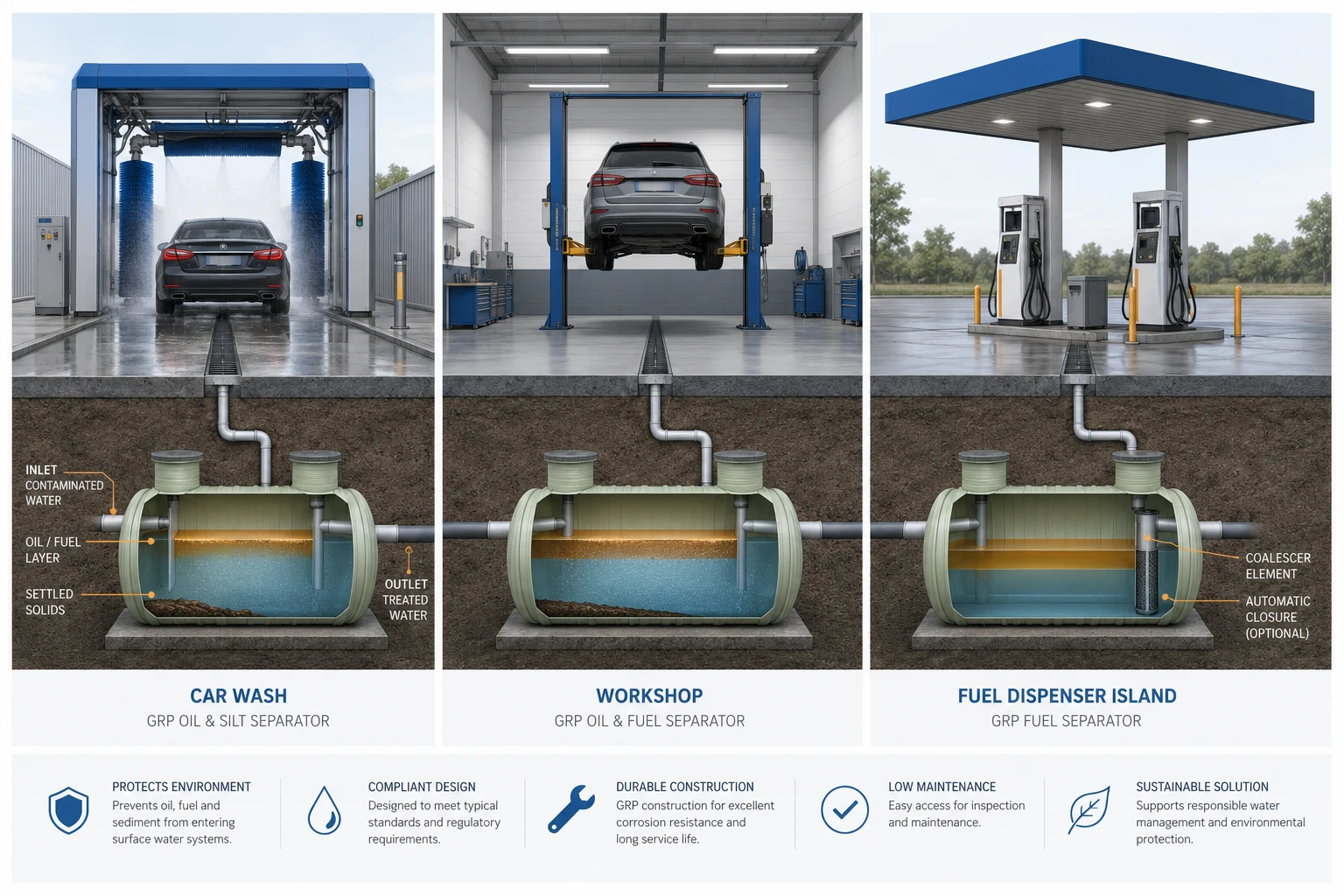
Oil water separators for car washes are essential across Saudi Arabia to remove oil, fuel, grit, and suspended solids before wastewater enters the drainage system. Workshops and fuel stations also require properly designed GRP oil-water separators to meet environmental regulations and ensure reliable long-term performance.
The three facility types fail differently when the separator is wrong. Car washes defeat separators with detergent emulsions and grit; workshops with degreasing solvents and shock discharges; fuel stations with spill events that a routine-duty separator was never designed to hold. Specifying “an oil-water separator” without the application analysis produces a compliant-looking installation that fails its first real test.
Saudi conditions sharpen each failure mode. Windblown sand loads silt chambers faster than temperate design assumptions anticipate; high temperatures accelerate detergent chemistry; and the density of fuel stations and car washes along Saudi corridors concentrates the cumulative discharge.
This article specifies the separator configuration for each facility type — chamber by chamber — with the sizing logic, accessories, and operating practices that make each installation work. The underlying separation physics is covered in the companion article on how GRP oil-water separators work.
The Common Architecture: Three Chambers, One Logic
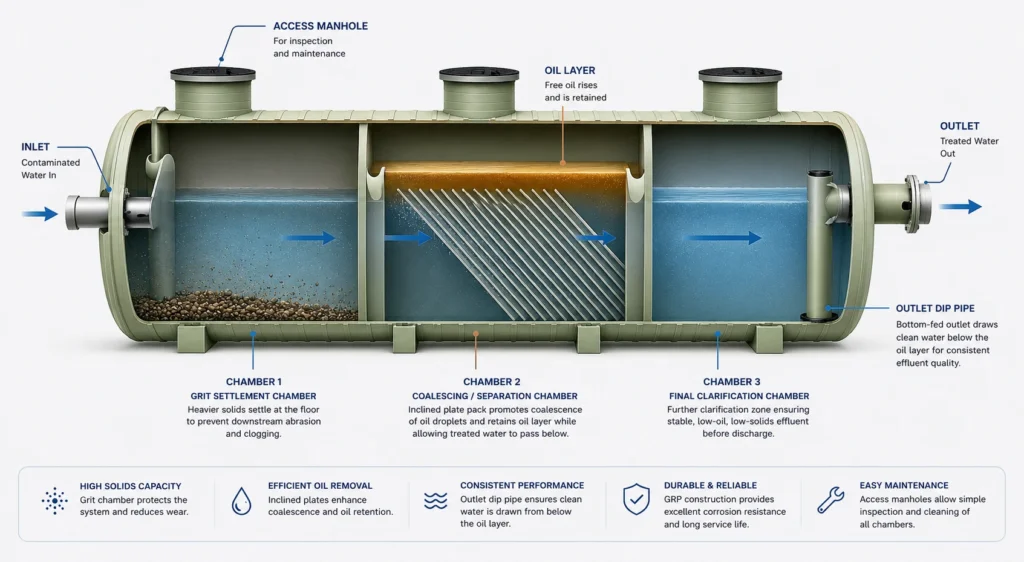
All three applications resolve into variations of the same treatment train:
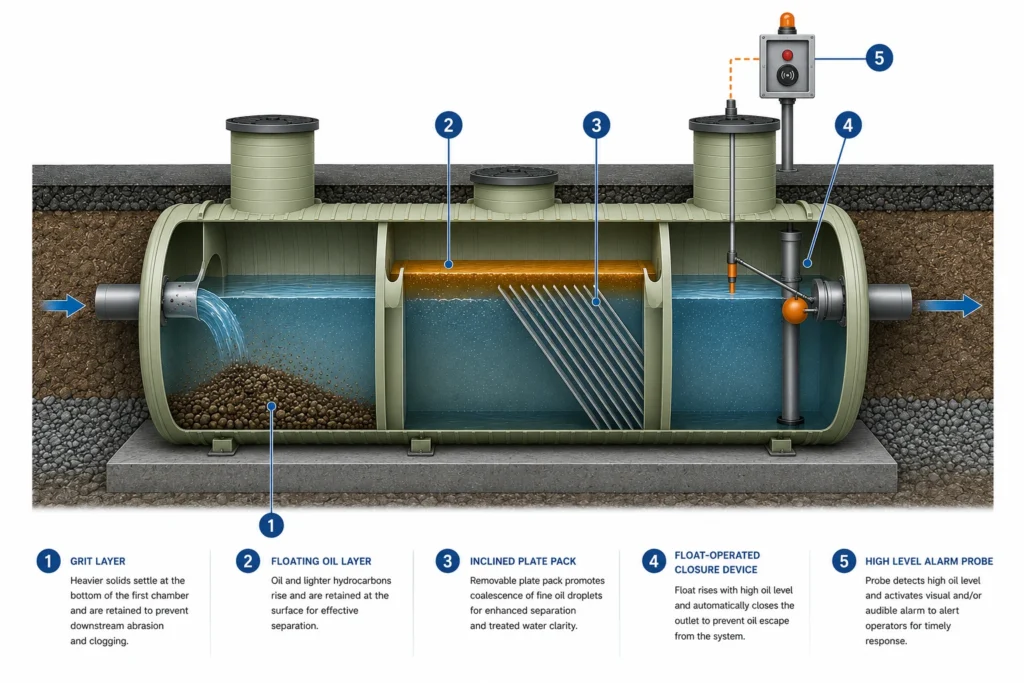
- Silt/sediment chamber — kills inlet velocity and settles grit before it reaches the separation stage.
- Separation chamber — gravity zone with coalescing plate pack (or media cartridge) capturing free oil down to ~20–60 microns.
- Outlet chamber — clarified draw-off from below the surface, with the compliance sampling point downstream.
| Chamber | Car Wash | Workshop | Fuel Station Forecourt |
|---|---|---|---|
| Silt chamber | Oversized — the critical chamber | Standard | Standard, sand-loaded |
| Separation stage | Coalescing, wide plate spacing (grit tolerance) | Coalescing, full retention | Coalescing, full retention |
| Oil storage volume | Moderate | Moderate | Large — spill capture duty |
| Automatic closure device | Optional | Recommended | Essential |
| Oil level alarm | Recommended | Recommended | Essential |
Application 1: Car Washes and Wash Bays
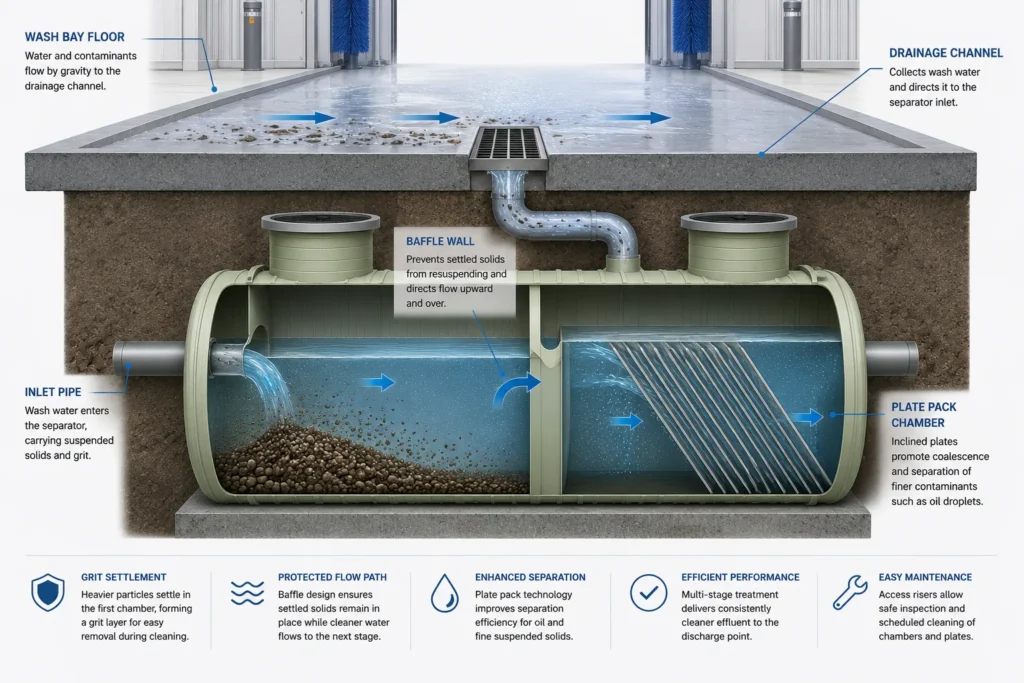
The car wash separator’s real enemies are grit and detergent — oil is the easy part.
Design Points
- Size the silt chamber first. Each vehicle wash in Saudi conditions carries sand and road grit into the drainage; an undersized silt chamber blinds the plate pack within weeks. As a working rule, provide silt storage of several hundred litres per wash bay and let measured accumulation set the emptying interval.
- Choose grit-tolerant plate geometry. Inclined flat-plate packs with wider spacing (12–20 mm) resist blinding better than tight corrugated packs in this duty.
- Confront the detergent question directly. Standard heavy-duty traffic film removers create stable emulsions that pass any passive separator. Specify quick-split (low-emulsifying) detergents as an operating condition of the facility — this single procurement decision determines whether the separator can meet its effluent number.
- Size on equipment flow, not guesswork. Sum the rated discharge of high-pressure lances, gantry/rollover machines (manufacturer data, commonly in the range of 60–130 L/min per machine), and floor washdown; apply the peak simultaneous case.
- Water recycling changes the duty. Recycling systems concentrate contaminants; the separator becomes part of the recycle loop, and its performance directly sets wash-water quality. State recycling intent at enquiry.
Operating rule for wash facilities: the separator’s effluent quality is decided at the detergent purchase order. No plate pack recovers oil that surfactants have locked into a stable emulsion.
Application 2: Vehicle Workshops and Service Centres
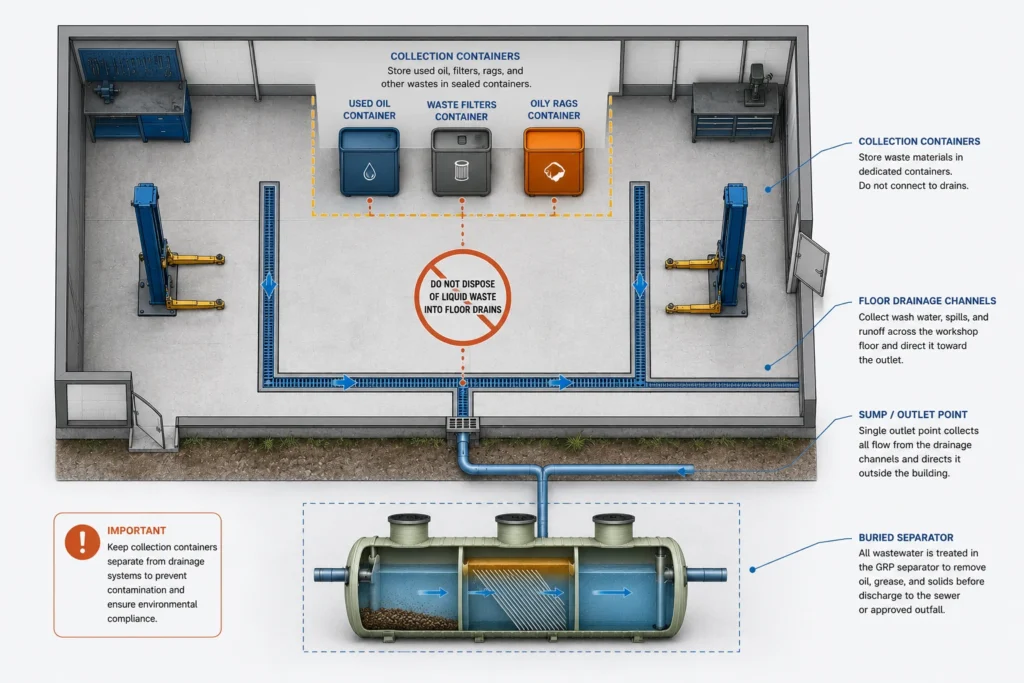
Workshop drainage is intermittent, chemically varied, and prone to the one discharge that matters — a spill.
Design Points
- Full retention, always. Workshop floors handle oil changes, fuel system work, and coolant — 100% of floor drainage passes through the separation stage.
- Segregate the waste streams upstream. Used engine oil, solvents, brake cleaner, and coolant are collected wastes, not drain discharges. The separator handles incidental floor washdown, not deliberate disposal — post this as a workshop rule.
- Watch the degreaser chemistry. As with car washes, solvent-based and strongly emulsifying degreasers defeat the separator; specify low-emulsifying floor cleaning products.
- No upstream pumping. Where a pit or basement level forces lifting, place the pump after the separator; pumped inflow shears oil into unseparable droplets.
- Size on washdown flow. Workshop peak flow is typically hose washdown (one or two hoses at 30–60 L/min each) plus any wash bay — modest flows, so units are compact, but oil storage should carry margin for the spill case.
Workshop Separator Selection Snapshot
| Parameter | Typical Small Workshop (2–4 bays) | Service Centre (6–12 bays) |
|---|---|---|
| Design flow | 1–2 L/s | 3–6 L/s |
| Configuration | Full retention coalescing | Full retention coalescing |
| Oil storage | With spill margin | With spill margin + alarm |
| Silt chamber | Standard | Standard–large (tyre/underbody work) |
Application 3: Fuel Station Forecourts
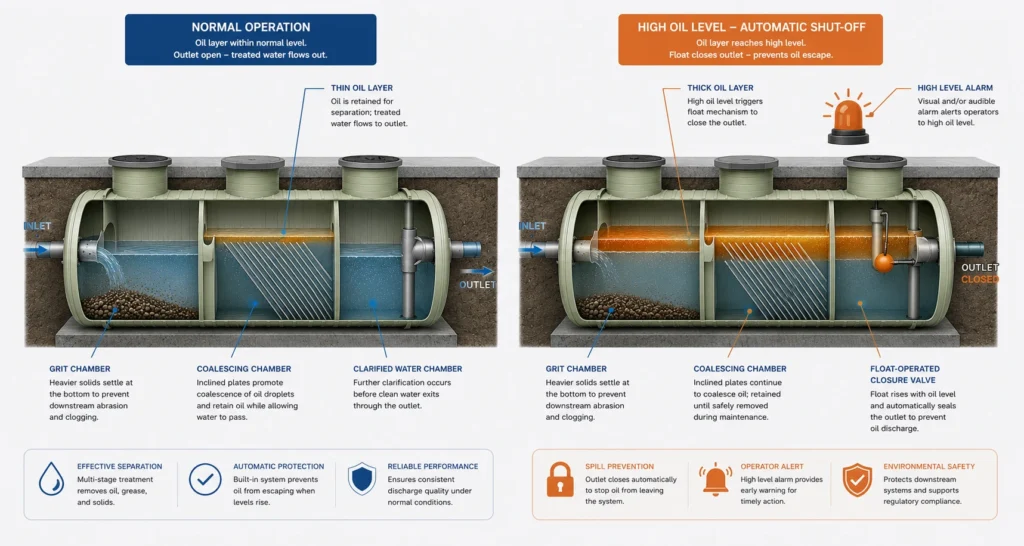
The forecourt separator is spill infrastructure first and drainage equipment second. Its defining duty is the day a delivery coupling fails or a dispenser is struck — the separator must capture the release, seal itself, and hold the fuel until recovery.
Design Points
- Full retention across the forecourt catchment. The paved area under and around the canopy — dispensers, offloading point, and their aprons — drains to the separator; treat 100% of the design flow.
- Size the flow on rainfall over the catchment. Design flow = catchment area × design rainfall intensity (with the local authority’s storm criteria). Saudi rainfall is infrequent but intense — short-duration cloudburst intensities govern, and the first flush after months of dry deposition is the dirtiest water the site will ever discharge.
- Size the oil storage on the credible spill. A common design basis is a compartment or delivery-hose release volume; agree the scenario with the operator and authority.
- Automatic closure device — essential. The density-calibrated float seals the outlet when stored light liquid reaches capacity, converting the separator into a sealed containment vessel during a spill.
- Oil level and closure alarms — essential. Wired to the station office/panel so a spill or full oil layer is an alerted event, not a discovery at the next service.
- Segregate roof and clean paving. Canopy roof water and non-operational paving bypass the separator — treating clean water wastes capacity and dilutes the first flush.
- Vapour-safe details. Fuel-duty separators need venting arranged for flammable vapour and access covers rated accordingly; state the fuel duty explicitly at enquiry so materials and details are specified for hydrocarbon service.
Why GRP for These Duties
All three applications reward the same vessel properties:
- Continuous hydrocarbon contact without coatings — chemical-resistant GRP laminates take fuel and oil exposure that consumes coated steel from the interface down.
- Verifiable watertightness — one-piece shells, hydrostatically tested before backfill (procedure in the FRP hydrotest guide); on fuel duty, containment integrity is the entire point.
- Corrosion immunity inside and out — sabkha soils, saline groundwater, and the tank’s own sludge zone attack steel and concrete by the same mechanisms detailed in the grease interceptor material comparison; GRP is indifferent to both sides.
- Installation speed — forecourts and wash facilities are revenue-per-day businesses; a one-piece GRP unit placed by excavator shortens the shutdown.
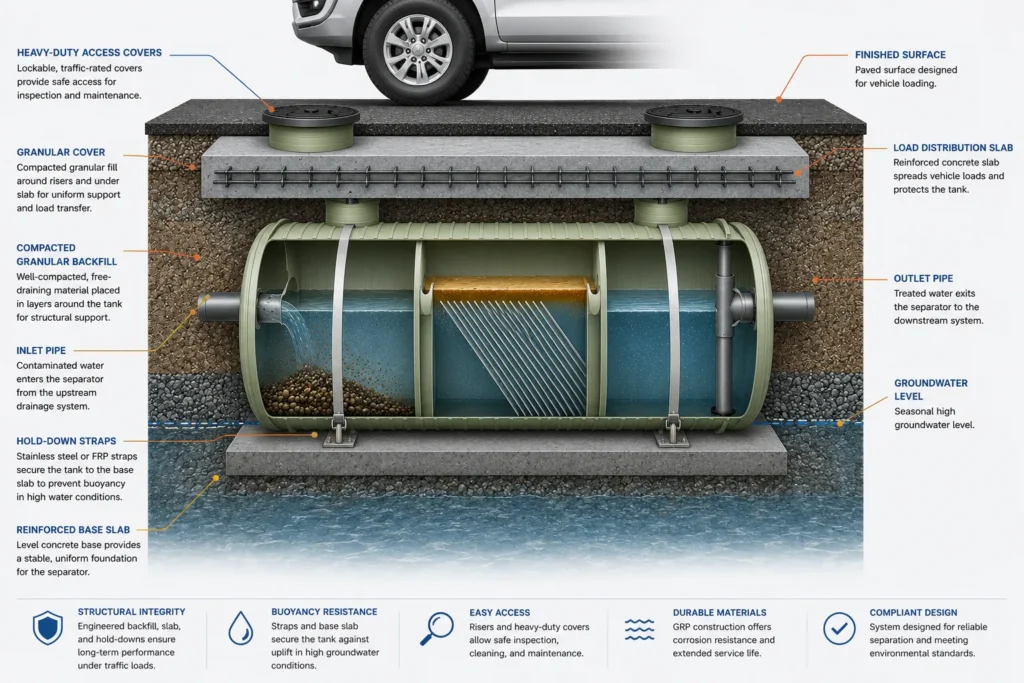
- Burial engineering — trafficked covers, load slabs, and anti-flotation anchoring follow the same discipline as any buried GRP tank (underground vs. above-ground guide); high water table coastal sites must declare groundwater at enquiry.
Operating and Maintenance Rhythm
Separator maintenance follows the same condition-based logic as grease interceptors, with different trigger layers:
- Monthly visual check — covers sealed, no surface sheen at the outlet manhole, alarm panel healthy.
- Dip the layers quarterly (monthly for car washes): measure the silt depth and oil layer thickness.
- Empty silt when the chamber reaches its design storage depth — at Saudi car washes this governs the schedule.
- Draw off oil before the layer approaches closure-device capacity; the recovered oil goes to a licensed waste-oil carrier with a manifest, mirroring the chain-of-custody discipline in the grease trap maintenance guide.
- Annual full service — evacuate, wash down, lift and inspect the plate pack, verify the closure float and alarms, refill with clean water, test-certificate the alarms.
- After any spill event — full evacuation and inspection before the unit returns to duty; reset the closure device per its procedure.
Specification Checklist by Application
| Item to State at Enquiry | Car Wash | Workshop | Fuel Station |
|---|---|---|---|
| Design flow basis | Equipment rated flows + bays | Washdown hoses + bays | Catchment area + rainfall intensity |
| Catchment area (m²) | Wash bays + aprons | Floor area drained | Forecourt paved area |
| Detergent/degreaser type | Quick-split confirmed | Low-emulsifying confirmed | N/A (fuel duty) |
| Effluent limit / consent | Provider figure | Provider figure | Provider figure + authority spill criteria |
| Closure device | Optional | Recommended | Essential |
| Alarms | Recommended | Recommended | Essential (oil + closure) |
| Cover loading | Light traffic | Light–medium | Heavy traffic rated |
| Groundwater level | Declare | Declare | Declare |
| Recycling system | Declare if fitted | — | — |
FAQs
1. Does a car wash need an oil-water separator in Saudi Arabia? Yes — wash-bay drainage carries oil, fuel residues, and grit, and discharge to the sewer is conditioned on pre-treatment. The effective configuration is a generously sized silt chamber followed by a full-retention coalescing separator, operated with quick-split detergents.
2. What size separator does a fuel station forecourt need? Flow capacity is sized on the forecourt catchment area multiplied by the local design rainfall intensity, and oil storage is sized on the credible spill scenario agreed with the operator and authority. Both figures, plus the paved area drawing, should accompany the enquiry.
3. Why is my separator passing oil even though it is the right size? The usual causes are detergent emulsification (the oil is chemically locked in suspension), a blinded plate pack from silt, or an upstream pump shearing the oil. Check the detergent specification first — no separator recovers a stable emulsion.
4. What is an automatic closure device and do I need one? It is a density-calibrated float that seals the separator outlet when the stored oil layer reaches capacity, preventing hydrocarbon discharge during a spill or missed service. It is essential on fuel forecourts and good practice at workshops.
5. How often should the silt chamber be emptied at a car wash? On measured accumulation rather than a fixed calendar — dip the grit depth monthly and empty at the design storage level. Saudi sand loads typically drive intervals of one to three months per busy wash bay, far shorter than temperate-climate assumptions.
6. Can wash water be recycled through the separator? Yes — many Saudi car washes run recycling loops in which the separator is the primary treatment stage, usually followed by filtration. Recycling concentrates contaminants and changes the duty, so declare it at enquiry so the unit is specified for the loop.
7. Should roof water from the fuel station canopy go through the separator? No. Clean roof and non-operational paving drainage bypasses the separator; routing it through wastes hydraulic capacity and dilutes the contaminated first flush that the unit exists to treat.
8. What happens to the oil removed from the separator? Recovered oil and oily sludge are transported by licensed waste carriers to approved facilities, with manifests retained in the site’s compliance records — the same chain-of-custody discipline applied to grease trap waste.
Conclusion
A vehicle-facility separator succeeds when the specification starts from the facility’s real behaviour: the grit per wash, the washdown hoses, the credible spill. Flow numbers, chamber proportions, detergent policy, and accessories all follow from that analysis — and a one-piece GRP vessel carries the result for decades without corrosion allowances or coating cycles.
For an application-specific selection and quotation, share the following with Pioneers Fiberglass:
- Project location in Saudi Arabia
- Facility type (car wash, workshop, fuel station) and scale (bays, hoses, forecourt area)
- Design flow data (equipment flows or catchment area) and any recycling system
- Required effluent limit or discharge consent conditions, and spill scenario for fuel duty
- Site conditions if relevant (soil type, water table, traffic loading) and timeline
Contact Pioneers Fiberglass for a project-specific consultation →